AI-Generated Content and Copyright: What Businesses Need to Know in 2026
If your team has been leaning on AI tools to generate blog posts, product images, or social content, here's a question worth asking before you publish the next one: who actually owns that content? For a lot of businesses, the honest answer is nobody, and that's a bigger problem than it sounds.
The Basic Question
The U.S. Copyright Office has been studying this since 2023, collecting public input and issuing guidance in stages. Its conclusion has stayed consistent throughout: copyright protection requires human authorship, and that requirement hasn't changed just because the tool doing the work became a lot more sophisticated.
The case that settled this at the federal level is
Thaler v. Perlmutter. A computer scientist generated an artwork entirely through an AI system and applied to register it, listing the AI system itself as the author. The Copyright Office refused registration, the D.C. Circuit Court of Appeals upheld that refusal in 2025, and on March 2, 2026, the Supreme Court declined to hear the case at all. That left the ruling standing: human authorship is a "bedrock requirement" of copyright, and content generated without meaningful human involvement simply falls outside it.
The harder, more practical question, one the Copyright Office has addressed in detail, is what happens when a human is the one typing the prompts. Its answer: prompts alone, no matter how detailed, generally don't make the person who wrote them the "author" of the output. A prompt functions more like an instruction than an expression, since the AI system is still the one making the real expressive choices, what the final image looks like, how a sentence is phrased, in between the prompt and the result.
Walking Through It
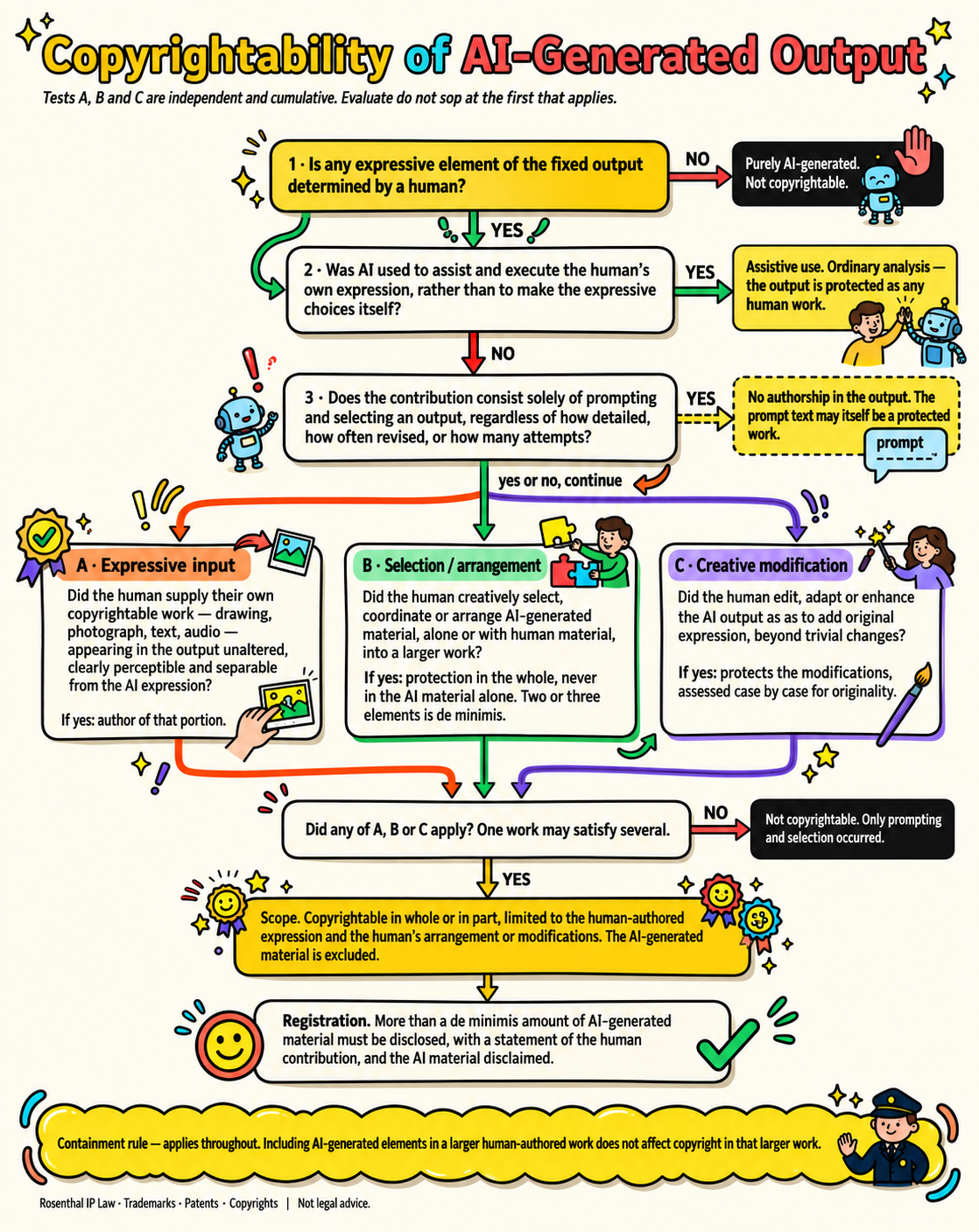
The flowchart above reflects a few key distinctions the Copyright Office has drawn, each worth understanding on its own:
- Purely AI-generated content, no meaningful human input, not protectable. If a prompt goes in and an output comes out with nothing else added, there's no copyright to claim, for anyone.
- AI used as an assistive tool — fully protectable, the normal way. If your team uses AI to edit, enhance, or refine something a person already created, rather than to replace their creative judgment, the resulting work is treated like any other human-authored work.
- A human's original input feeds into AI output — the human's original contribution keeps its own protection. If someone creates original artwork or text and then runs it through an AI tool to modify or extend it, that original expression doesn't lose its copyright just because AI touched it afterward.
- Selecting and arranging AI-generated material — can be protected as a compilation. Deliberately curating and organizing a set of AI-generated elements into something cohesive can itself be a protectable creative act, even if the individual AI-generated pieces aren't. This is exactly what happened in one real registration case, Zarya of the Dawn, a comic book combining AI-generated images with human-written text: the Copyright Office found the overall compilation protectable, while the individual AI images were not.
- Substantial human modification of AI output — protectable to the extent of the changes. If a person reworks AI-generated material enough that the changes themselves reflect real creative judgment, those specific modifications can be copyrighted, even though the unmodified AI output underneath still isn't.
One more detail worth knowing: if you're registering a work that includes AI-generated material, the Copyright Office requires you to disclose that and describe the human author's actual contribution. Registrations only cover the human-authored portion, and getting this disclosure wrong can put the validity of the registration itself at risk.
What This Means for Your Business
Treat purely AI-generated output, generated from a prompt with no further human work layered on, as unprotected. Keep records of what a person actually selected, edited, or arranged, since that documentation is what determines whether there's anything protectable at all. If you're registering AI-assisted content, disclose the AI-generated portions accurately. And remember that your ability to commercially use AI output is often governed by the AI platform's own terms of service, separately from anything copyright law covers.
This is still a developing area, and the Copyright Office has said it will keep monitoring the technology as it evolves. But the core rule, as it stands now, is settled: no meaningful human authorship means no copyright.
If your business is relying on AI-generated content and isn't sure what's actually protected, or how to document your process so that it is, that's worth sorting out before you build a brand asset around something you don't actually own.
Contact Rosenthal IP Law today to schedule a consultation on protecting the content your business is creating, AI-assisted or otherwise.